Monday, September 28, 2015


Double Your Standard – Double Your Fun

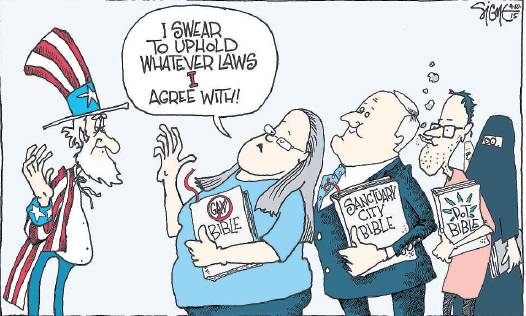
I was out there on Facebook, which requires being out there, when I saw this political cartoon. It really yanked my chain. It wasn’t my view of the issue it’s speaking to that wound me up. It’s the problem of double standards in our culture that burned me.
I should give a caveat here. With the examples I’ve presenting here, I’m not going to speak to my position on any of them. That’s not the point of this blog. My focus is strictly dealing with how so many today hold double standards without even realizing it.
The underlying reason for this is the loss of a moral foundation. When there are no longer any absolutes, we are left with a rudderless ship. Everyone thinks they’re the captain and are so busy fighting they don’t see the iceberg. It feels like we’re just rearranging deck chairs on the Titanic and there’s already water on the deck.
So, back to the cartoon. The problem I found is, some are angry because they see an individual whom they believe is ignoring the laws they were hired to carry out. At the same time they ignore the fact that those they support in Washington are doing exactly the same thing. “But they want what’s best for us. So they have to ignore laws that interfere with doing what they know should be done.” (Oh, and by the way, congress exempts itself from much of what it places on us.) So do you think this occurs on only one side of the aisle? Can you say “double standard?”
Now I’m a child of the 60’s. Yes, I know that makes me old. Well, back in the day many young people fought for freedom of speech. They wanted to say what they believed needed to be said, even if what they said was believed to be ugly and hateful by those who opposed them. They eventually won!
Today it is many of these same people who claim to continue to support free speech—that is, unless they disagree with you. It that case what you say is ugly and hateful. So your words are defined as hate speech. And those who fought to say what they wanted now fight to keep you from having the same freedom. Can you say “double standard?”
The meaning of tolerance has been redefined. Where once it meant: I can disagree with you but it’s not my job to change you. Today it means not only do I have allow you to live as you want, I’m not even allowed to disagree with you. In fact I have to embrace what I believe to be wrong. And if I don’t, then you won’t tolerate me. Can you say “double standard?”
I don’t expect things to change. In fact they will probably get worse. So what’s my point? Christians cannot live by a double standard. If we define same sex marriage as wrong, then how can we excuse adultery, fornication, and divorce (without biblical cause) at the same time? If we are going to present a biblical definition of marriage, then we must defend marriage on all fronts, otherwise — can you say “double standard?”
We must not only stand firm for biblical truth but we must live it. We won’t always succeed. But when we fail and sin, then we must repent, that is, ask God’s forgiveness and for forgiveness from those we have sinned against. Otherwise we are living by a double standard. Can you say “hypocrite?”
If we are to not buy into a world of double standards, then we must live by Christ’s words. “Judge not, that you be not judged. For with the judgment you pronounce you will be judged, and with the measure you use it will be measured to you. Why do you see the speck that is in your brother’s eye, but do not notice the log that is in your own eye? Or how can you say to your brother, ‘Let me take the speck out of your eye,’ when there is the log in your own eye? You hypocrite, first take the log out of your own eye, and then you will see clearly to take the speck out of your brother’s eye” (Matthew 7:1–5 ESV).
While we are called to judge sin, we aren’t to so some from a place of arrogance or a judgmental spirit. We must recognize that when we do so, we can easily fall into the trap of setting a double standard, which means living hypocritically. So no matter how much the world lives by double standards, let’s show as believers we can be tolerant, civil, and most importantly, humble and loving. Let us reflect Christ’s love and mercy. Let us remind the lost that God doesn’t have a double standard. He offers the gift of salvation to all and there are consequences to all who reject it.
“For God so loved the world, that he gave his only Son, that whoever believes in him should not perish but have eternal life. For God did not send his Son into the world to condemn the world, but in order that the world might be saved through him. Whoever believes in him is not condemned, but whoever does not believe is condemned already, because he has not believed in the name of the only Son of God. And this is the judgment: the light has come into the world, and people loved the darkness rather than the light because their works were evil. For everyone who does wicked things hates the light and does not come to the light, lest his works should be exposed. But whoever does what is true comes to the light, so that it may be clearly seen that his works have been carried out in God” (John 3:16–21 ESV).

Wednesday, July 31, 2013

Back in the day I was involved in a publication "Morning Star" magazine. It was primarily an e-magazine, before anyone knew what this meant. It went world-wide via bulletin boards. One of the articles I wrote for it dealt with the question of God's healing for today. Since this comes up so often, I thought I'd reprint it here. I hope you find it a blessing.


Does God Heal? 

I     Introduction: There is much suffering in the world today. Many people are in pain. They suffer from physical disease, everything from asthma and allergies, all the way to life-threatening illnesses such as AIDS and MS. Disease is a major problem of life, one which can affect anyone regardless of their race, age, social position or material prosperity. It affects all, Christian and non-Christian alike.

But the presence of illness in this world brings up an added difficulty within the Christian community. The problem is some Christians believe in healing and others do not. Some teach that when Christ died He provided healing for any and all disease. Others believe that God allows us to suffer from illness and doesn't intend us to be healed. Finally, there is the middle ground which holds that God can and does heal—when He desires to—leaving us suffering from disease when He knows we will benefit spiritually in the midst of that affliction.

There is a substantial amount of disagreement over the whole issue of God's healing. Did God heal? If God did, does He still do so? Did Messiah's death and resurrection on the cross provide healing for all individuals? How should we pray when confronted with illness? In this blog I’ll endeavor to deal with these touchy questions.

When discussing a Biblical perspective on healing there is only one place to start and that is with God's word. What does Scripture teach about healing?

II   With His Stripes: First, let us examine a passage that is frequently used to support a view that not only does God heal, but it is His intent that no believer suffer from physical illness:

“ But he was pierced for our transgressions; he was crushed for our iniquities; upon him was the chastisement that brought us peace, and with his wounds we are healed” (Isaiah 53:5 ESV).

This is a very familiar passage and, as already noted, some take it to mean that with Messiah's death and resurrection comes the promise of healing for all believers. But is this what the passage really teaches?

We have one expert on this passage. The Apostle Simon Peter said,

“ He himself bore our sins in his body on the tree, that we might die to sin and live to righteousness. By his wounds you have been healed” (1 Peter 2:24 ESV).

While it can be argued that some of the Jews of Jesus day saw miracles as a fulfillment of the Isaiah passage, Peter appears to move it out of the context of the physical into one of the spiritual. What were we healed from? We have been healed from SIN.

But in reality, Peter is consistent with the context of the Isaiah passage which focuses on the sin of those who are looking up at the suffering servant, at Yeshua. The whole of His suffering was directed at paying the price for sin. The thrust of the passage is not concerned with physical illness. Clearly, if one looks at the entire section versus part of one verse, the focus is with that fatal illness which ends in spiritual death: SIN and what Messiah suffered so that we would be healed of our transgressions.

Regardless of what some teach, the passage has nothing to do with God healing people from illness. To believe anything else is to have much lower view of the verse than the author intends. It teaches something much more important than physical healing. It offers the only answer there is to sin:  the suffering of our savior. The message of Isaiah is the glorious message of the Gospel:  by God's grace we are saved from an eternity in Hell to an eternity in His presence.

III  God Heals – Old Testament Examples: However, this does not mean that Scripture does not teach that God heals illness. We find numerous passages within the Old Testament showing that God heals, including the raising of the dead. Consider this example involving the prophet Elisha.

“ When Elisha came into the house, he saw the child lying dead on his bed. So he went in and shut the door behind the two of them and prayed to the LORD. Then he went up and lay on the child, putting his mouth on his mouth, his eyes on his eyes, and his hands on his hands. And as he stretched himself upon him, the flesh of the child became warm. Then he got up again and walked once back and forth in the house, and went up and stretched himself upon him. The child sneezed seven times, and the child opened his eyes” (2 Kings 4:32–35 ESV).

As the reader moves through the Old Testament, the healing mercy of God is demonstrated on numerous occasions.

IV  God Heals – New Testament Examples: In the New Testament it is also very clear that Jesus healed illness. It fact it is important that we look at the factors involved in His healings. When Jesus healed, people were completely and permanently healed.

“ And behold, a leper came to him and knelt before him, saying, “Lord, if you will, you can make me clean.” And Jesus stretched out his hand and touched him, saying, “I will; be clean.” And immediately his leprosy was cleansed” (Matthew 8:2–3 ESV; see Matthew 9:1-8; Mark 5).

Jesus brought back the dead.

“ As he drew near to the gate of the town, behold, a man who had died was being carried out, the only son of his mother, and she was a widow, and a considerable crowd from the town was with her. And when the Lord saw her, he had compassion on her and said to her, “Do not weep.” Then he came up and touched the bier, and the bearers stood still. And he said, “Young man, I say to you, arise.” And the dead man sat up and began to speak, and Jesus gave him to his mother” (Luke 7:12–15 ESV).

Jesus healed all who came to Him, as we see throughout the Gospels and in these examples.

“ So his fame spread throughout all Syria, and they brought him all the sick, those afflicted with various diseases and pains, those oppressed by demons, epileptics, and paralytics, and he healed them.”…“That evening they brought to him many who were oppressed by demons, and he cast out the spirits with a word and healed all who were sick” (Matthew 4:24; 8:16 ESV).

It is also worth noting that while Jesus said in many cases it was faith in Him that lead to healing, it was not necessary to have faith to be healed. In John chapter 5, we read of the healing of a crippled man who not only didn't have faith in Jesus, he didn't even know who Jesus was. As far as Jesus' ministry went, all who came to be healed were healed. Generally, there wasn't even an issue of having enough faith. How contrary to the teaching that if you aren't healed it is because of your lack of faith!

V Jesus Healed – With a Touch – Instantaneously – Totally: Before moving on to other New Testament areas, it should be noted that the miracles performed by Jesus were primarily for the purpose of authenticating God sending Him to the Jew. Almost all that he did was done within the context of His ministry to Judah and the Jew. His healing of Gentiles was by exception. John makes the authenticating purpose clear when he said,

“ Now Jesus did many other signs in the presence of the disciples, which are not written in this book; but these are written so that you may believe that Jesus is the Christ, the Son of God, and that by believing you may have life in his name” (John 20:30–31 ESV).

Essentially, no ministry today needs this type of authentication, as we have the testimony to it within Scripture with the works of Messiah.

VI  The Apostles Healed: But as far as the issue of healing goes, things changed with the ascension of Jesus to Heaven. While the Apostles healed, God no longer heals everyone who desires to be healed. After the death and resurrection of Messiah, God no longer carried out a wholesale healing ministry.  So much for healing being a product of Messiah's work on the cross!

The apostles and others who were around Jesus did heal, but in a much more limited way than the Lord. Even here, the healing was an authentication of their ministry (see Acts 3). But when they did heal, they carried it out in exactly the same way that Jesus did, that is, with a touch - instantaneously  and completely, even raising of the dead.

As we move on into the early period of the church, we find that even Paul didn't heal. Philippians 2:25-27 gives an account of Epaphroditus who almost died and was healed, not by Paul, but by God. Paul didn't heal Timothy of stomach problems; instead, he suggested taking some wine (see 1 Timothy 5:23), essentially a recommendation for medical treatment.

Finally, we know that God does not intend everyone to be healed because Paul himself suffered from a condition which he prayed about, and God chose not to heal him:

“ So to keep me from becoming conceited because of the surpassing greatness of the revelations, a thorn was given me in the flesh, a messenger of Satan to harass me, to keep me from becoming conceited. Three times I pleaded with the Lord about this, that it should leave me. But he said to me, “My grace is sufficient for you, for my power is made perfect in weakness.” Therefore I will boast all the more gladly of my weaknesses, so that the power of Christ may rest upon me” (2 Corinthians 12:7–9 ESV).

This passage shows a most important principle. God not only doesn't always heal, but he allows illness as a way for us to be more dependent on Him. Clearly Paul is teaching that God is more concerned with our spiritual than our physical health, even to the extent that He allows Satan to torment us for our spiritual growth, just as He allowed Satan to do with Job. (It should be noted here that obviously God doesn't always intend us to be free from the persecution of Satan and his followers, but allows them leeway in our life for our growth.)

VII  Growth Comes Through Suffering: This brings us to the real issue regarding healing. Scripture does teach that God heals, and still heals today. What Scripture does not teach is that God intends Christians to be without disease, that God intends all believers to be healed from illness and if we aren't, it is simply because we don't have enough faith. To the contrary, illness is one of the things God uses to keep us dependent on Him.

There are essentially three principles that underlie this truth.

1)   God is sovereign. It is not up to us to demand that God heal. It is up to Him to decide what is in our best interest, which may be to allow us to remain in our stricken condition.

“ Then the Lord said to him, “Who has made man’s mouth? Who makes him mute, or deaf, or seeing, or blind? Is it not I, the Lord?” (Exodus 4:11 ESV).

Again, remember God's words to Paul:

“ My grace is sufficient for you, for my power is made perfect in weakness” (2 Corinthians 12:9 ESV).

Who are we to say, "God heal me!" when He chooses not to?

2)   Clearly, God is more concerned with our souls than our bodies.

“ And do not fear those who kill the body but cannot kill the soul. Rather fear him who can destroy both soul and body in hell” (Matthew 10:28 ESV)

Scripture does not teach that God desires our happiness. What He desires is our maturity. All suffering can bring us benefit.

“ And we know that for those who love God all things work together for good, for those who are called according to his purpose” (Romans 8:28 ESV)

Now does this mean all things except disease, or does it really mean all things? Listen to the words of Peter, the great Apostle, one who healed others himself.

“ Beloved, do not be surprised at the fiery trial when it comes upon you to test you, as though something strange were happening to you. But rejoice insofar as you share Christ’s sufferings, that you may also rejoice and be glad when his glory is revealed” (1 Peter 4:12–13 ESV).

Now while Peter is talking about the suffering that comes from standing for Christ as a witness for Him, how we stand faithful in our pain is also a witness for Him. Notice then that we are not to be surprised by suffering. We are not to demand that God heal us. We are to rejoice that we are allowed to suffer so that God will be glorified through our dependence on Him.

We have certainly seen this principle of God using the suffering of believers to His glory. Joni Eareckson Tada, a paraplegic, has had the opportunity to touch the lives of many physically challenged individuals because of her willingness to accept God's decision to remain in her chair.

Merrill Womach, the great singer, has had an outstanding testimony for the Lord despite the fact that his body and his face are scarred by the act of a fire through which he suffered.

Then there is the great Hymn writer Fannie Crosby who, in the midst of her blindness, wrote some of the outstanding standards of the church. Among her great works are “To God Be The Glory,” “Tell Me The Old, Old Story,” and “Blessed Assurance.” As she wrote “Perfect submission, perfect delight! Visions of rapture now burst on my sight,” in the midst of her blindness, she kept her “eyes” on her Lord.

Think how great the loss to the church if God choose to heal all of His children. Think of the loss of testimony to the world of those who say their faith is in God, not in God's changing their circumstances.

VIII  Conclusion: First and foremost, we can praise the Lord, for He is a loving God and as such, God did and does still heal His afflicted children.

“ And this is the confidence that we have toward him, that if we ask anything according to his will he hears us” (1 John 5:14 ESV).

The key here is though according to HIS will, not ours. God does heal when He knows it is appropriate.

God still heals directly today in miraculous ways. God also heals through competent medical practice, sometimes even by physicians who are believers. In fact, James teaches that we are to pray and get medical care.

“ Is anyone among you sick? Let him call for the elders of the church, and let them pray over him, anointing him with oil in the name of the Lord” (James 5:14 ESV).

Oil in this context is the best understood as medical treatment.

As believers though, our primary concern should not be on physical recovery. Our purpose is to live in a way that glorifies God and brings honor to his name. How we continue to trust in Him in the midst of pain says more about our relationship with Him to a fallen world than how He makes life easy for us. After all, Scripture says of God:

“ For he makes his sun rise on the evil and on the good, and sends rain on the just and on the unjust” (Matthew 5:45 ESV).

Everyone in the world suffers. The difference between the Believer and Non-believer is what they bring out of that suffering and accordingly model about God’s grace before a lost world.

We must be willing to say that our joy or life does not come from God choosing to heal us. It comes for the quality of our relationship with Him in the midst of circumstances. Let us not boast in what God has done for us, but who God is. Paul puts it best when he said,

“ If I must boast, I will boast of the things that show my weakness” (2 Corinthians 11:30 ESV).

As believers, we are called to "walk on water," that is, to walk in dependency on the Lord in the midst of the trials and tribulations. We do this by keeping our focus on Him. Peter stepped out of the boat and did walk on the waves. He only began to sink when he took his eyes of the Lord and put them on the waves (see Matthew 14:22-31).

As we deal with the waves of illness, the waves of pain, the waves of suffering, let us not demand that God take us out of the water, but instead, keeping our eyes on Him, walking in His ways in the midst of the waves, knowing that He will heal us if he chooses, but that we can rejoice in Him even if he doesn't. Again, remember the words of Paul:

“ And we know that for those who love God all things work together for good, for those who are called according to his purpose” (Romans 8:28 ESV).

That means that both in times of peace and comfort, and in times of pain and upheaval, as believers we can rejoice because our loving Father is in control.

Let us pray that we will grow in our willingness to trust the Lord to the control of our lives, and instead of looking at the waves, we will keep our eyes on Him. Instead of demanding physical health, let us pray for spiritual maturity, accepting all that God brings to us as for our own good. And as we so live, then one day we will stand before Him and hear,

“ His master said to him, ‘Well done, good and faithful servant. You have been faithful over a little; I will set you over much. Enter into the joy of your master.’” (Matthew 25:21 ESV).

Even so — come Lord Jesus!

© Copyright 2013 Sepher Ministries

Saturday, May 4, 2013

So Many Translations – Argggggh


It’s been quite a while since I wrote a book review. But for this blog I’m going to review two. They both deal with the same subject:  modern biblical translations. This is a subject that stirs quite a bit of controversy, from the “King James Only” groups to concerns over paraphrases and “gender neutral” translations.


Back in the mid-nineties one of the best books on biblical texts was The King James Only Controversy by James R. White. I’ll say right from the start that, while I grew up with the King James Bible and love it,  there was never a question for me as to it being the only legitimate translation. It clearly isn’t.

Consequently the primary reason I appreciate White’s book is because in the midst of dealing with the “controversy”, it serves as an “introduction to the history and background of the biblical text, the primary area of attack by secularists in our world today.” [1]

It is because of this material I recommend the book, even if the reader isn’t interested in or concerned with the KJV battle per se. James White is not interested in undermining the KJV translation. Instead he speaks to the questions …

“Is your Bible translation reliable? Is it the real Bible? Answering those who claim that only the King James Version is the Word of God, James R. White examines allegations that modern translators conspired to corrupt Scripture and led believers away from true Christian faith. First published in 1995, and revised and expanded in 2009, The King James Only Controversy traces the development of Bible translations old and new and investigates the differences between newer versions and the Authorized Version of 1611. White’s teaching clearly shows why we can trust the accuracy of the Bible as God’s Word.” [2]


But it isn’t this book that drove me to write this review, it is a brand new book by Dave Brunn, One Bible, Many Versions. The book subtitled “Are All Translations Created Equal?” expands on the concepts of White’s book, providing a greater understanding of English translations. Here the author speaks to the broader area of how translators work.

“Dave Brunn is director of education for New Tribes Mission Missionary Training Center and was phonetics instructor at the NTM Language and Linguistics Institute (1978-1980). [3] He did extensive work for New Tribes Mission in Papua New Guinea, translating the Bible into the language of the Lamogai people.

This translating work created an interesting perspective because of the unique aspects of the Lamogai language and the related difficulties in translating the Bible. The factors involved with this work are what caused him to begin his analysis of the choices made in the numerous English translations of the Bible.

Mr. Brunn’s primary focus is on asking questions related to the distinctions between the English translations being used today. He is especially concerned with what he describes as “real world of translation practice.” [4]

The distinctions many translators make about the translations they are involved with are in describing them as essentially a word-for-word equivalence versus the dynamic equivalence. This forces a discussion of original language versus original meaning.

What made this book absolutely fascinating was how often the “word-for-word” translations resorted to dynamic equivalence and visa versa. The book has numerous charts analyzing individual words and passages in each referred-to translation and how the translation was different than one might expect.

As with White’s book, Brunn doesn’t have an agenda other than to help the reader understand a very complicated subject and how decisions are made in the translation process. As for myself, the conclusion I’ve come to is that believing any one translation is better than any other by cherry picking verses is not going to lead to a reliable decision. In fact, I believe Brunn’s book demonstrates the benefit of working in multiple translations.

“Dave Brunn has been involved in Bible translation work around the world for many years. From the perspective of this on-the-ground experience in different cultures, he helps us sort out the many competing claims for various English Bible translations. By giving us a better understanding of the process of translation, he demonstrates how the variety of translations enables us to more fully grasp the meaning of the biblical text. Meticulously researched, this clear, readable and informative work is poised to transform the conversation about Bible translation.” [5]

Because these two books give such a comprehensive understanding of the numerous aspects involved in bringing us English translations and written in such an accessible way I recommend them for both clergy and the people in the pews. I suggest as pastors we all have them in our library, read them, and if you find them helpful, recommend them to others.


[1] White, James, The King James Only Controversy, Bethany House, Minneapolis, MN, 1995, 2009, p.  19.
[2] Ibid, Back Cover.
[3] Brunn, Dave, One Bible, Many Versions, IVP Academic, Downers Grove, IL, 2013, Back Cover.
[4] Ibid, p. 16
[5] Ibid., Back Cover.

Wednesday, February 8, 2012

The Techno Savvy Christian


Being an old geezer and a counselor, one of the areas I have to constantly rethink is my view of the “social networking” trend. Listening to a recent WelsTech podcast (welstech.wels.net) again brought this to mind.

I do think a little background might be helpful here. While I’m not a full blown techie, I’ve been involved in online ministry since the 80’s. Back in the day I was one of the editors of “Morning Star” magazine. This publication went world-wide via bulletin boards (check Goggle for those to young to know what that is), and was published monthly for about four years. It was the equivalent of 40 plus pages per month and included Bible studies, Christian living articles, interviews, and miscellaneous small pieces.

For a period of time I also was a host and advisor to a number of Christian chat rooms on AOL. In fact for a short period of time I was actually an employee of that renown company.

Even today I’m still use the online world for outreach opportunities, serving as pastoral advisor to the Christian Fellowship Ministry (CFDevotionals.org), and posting thoughts daily on Facebook and Goggle+. (Contact me if you want to be added to the email distribution list at GKragen@aol.com.)

So clearly I’m not a technophobe. Technology can be used for good or ill. While there are outreach opportunities on the internet some can’t minister there because of their own struggles and the temptations.

But getting back to the WelsTech subject that stimulated this column, I want to touch on the issue of social networking as “community.”

As believers in local churches we need to understand how, for want of a more familiar tool, Facebook can be used to enhance community or create the illusion of it. For members of a local church using a Facebook tool like “Close Friends” we can create a forum for prayer requests and discussing sermons or class discussions, etc. (By the way I think this may be a bit easier to do at Goggle+ but I don’t spend enough time on either to have an informed position.) In any case, we find there is community because community already exists.

On the other hand having numerous “friendships,” made on line, can create the illusion of community. Community is created by relationship and relationship is not generally built in the arms length environment of a social network. While relationships can be started online it takes investment of time, commonality, and emotional contact to deepen them. This is where the balance between “real” and “virtual” becomes clouded. (Second life is a good example of the merging of the two, virtual and real. [Secondlife.com])

Having said this, relationship can, with the investment of time, be built even in the electronic world. After working with other editors and staff of “Morning Star” we got to know one another pretty well even though the majority of the staff was back east and in the south. Only three of us were here on the left coast, one of whom was my wife. I never met any of the staff face-to-face, though a few of the others did.

I believe, as the use of the online world expands, believers will be challenged to see the opportunities, challenges, and dangers. But I don’t know we will be able to discover fixed answers to general questions because the technology keeps changing.

As with any other opportunity of “go and make disciples,” we will have to grow in our understanding of these environs. This means, even if we’re not techies, we still have to keep up with the social impact of technology. So we read the Word, we pray, we are filled with the Spirit, and we keep on informing ourselves about the world around us. When we do this we will continue to have impact for the Truth.

Friday, January 6, 2012

How about a little peace and quiet

We are at the start of a new year. The stock market has started to recover. Foreclosures are down and new unemployment insurance claims have fallen. Finally things are turning around. Or are they? 

If you heave a sigh of relief at the "good" news then you need to stop and ask, "Where do I get my security?". How will I feel when the news is "bad." Many people, like the stock market, are emotionally tossed to and fro by circumstances. (This is one of the reasons I suggest not reading the newspaper, especially here on the "left" coast.)

I don't know about you, but personally, life is difficult enough without letting the things over which I have no control, control me.

True peace can only come if our security is in God not changed circumstances. Be clear, I'm not suggesting we aren't impacted by the struggles of life. But what I am saying is, as we exercise faith in the God who is faithful we will not be emotionally overwhelmed by the struggles of life. Paul expressed it best when he stated:


Rejoice in the Lord always; again I will say, rejoice. Let your reasonableness be known to everyone. The Lord is at hand; do not be anxious about anything, but in everything by prayer and supplication with thanksgiving let your requests be made known to God. And the peace of God, which surpasses all understanding, will guard your hearts and your minds in Christ Jesus” (Philippians 4:4–7 ESV).

I pray that this year will be typified by you experiencing God's peace in all circumstances. 

Thursday, November 3, 2011

This is to serve as an introduction to my first attempts at blogging. The inspiration to do this comes from two sources. The first is a five week intensive training I just completed. It is an Introduction to Christian Coaching. The second is Lisa Leiplein who writes excellent pieces.

I'm not sure how often I will post something here, probably only as the Lord lays something on my heart, something which is driving me "Out of My Mind."

I suspect most will deal with issues of the Christian walk, and maybe counseling issues. I guess you'll find out what I have to say when I do. So I hope to see you soon.

Until then Shalom and Aloha.